
Abjection and Empowerment in The Female Werewolf
When the true monster is the hairy woman with sharp teeth and shaper hunger. You can keep your razor. Welcome to my lair.

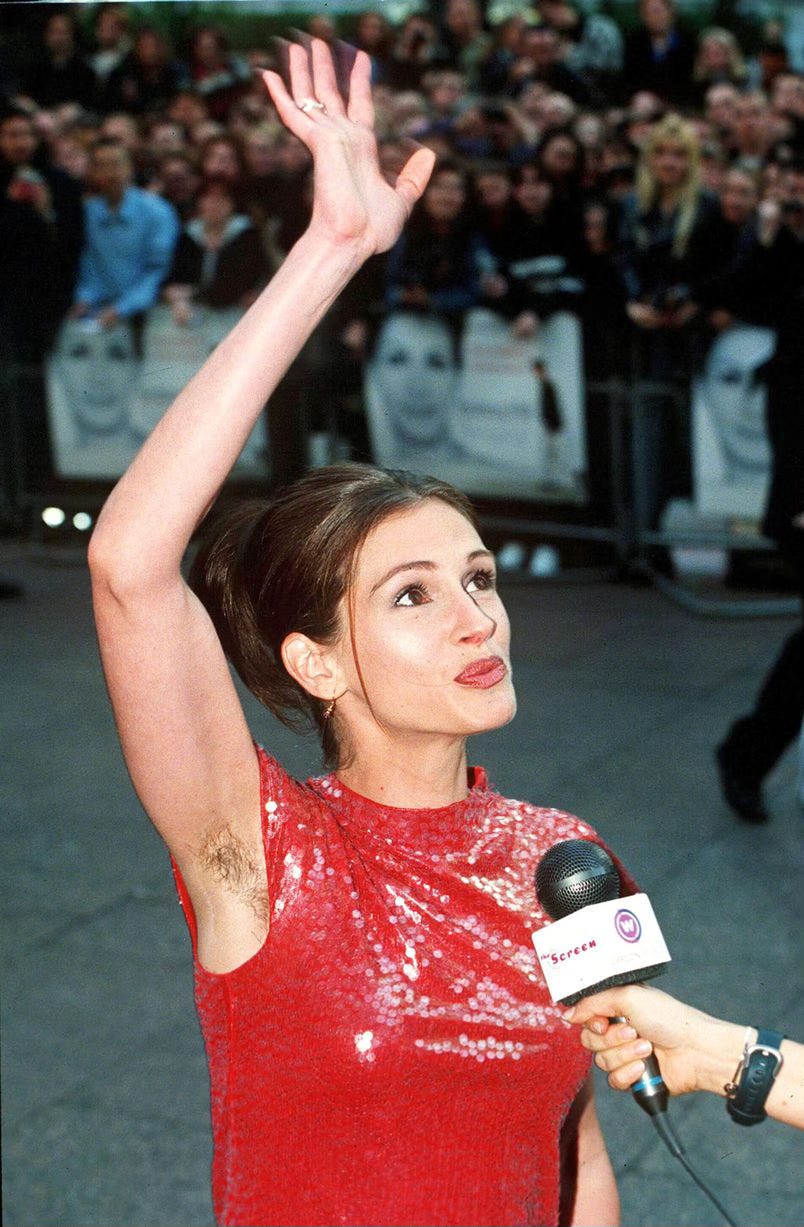
Picture this: Julia Roberts at the 1999 premier of Notting Hill. Make-up and hair done to Hollywood perfection, Roberts, wrapped in a bright red sequin designer gown. America’s Sweetheart raises her hand to wave at the camera and what’s revealed? A dark, hairy thatch of underarm hair.
Cue a collective cultural shudder.
It is this, our pop-culture’s preoccupation with so-called “excess” female body hair, that has led me to consider the female werewolf, and why she is quite rare in horror cinema. The rarity of the female werewolf, I believe, has to do with her extreme monstrosity, the intersection of woman and wolf that disrupts Western social expectations for smooth female bodies, what Julia Kristeva identifies as the “abject,” that which “disturbs identity, system, order.” Indeed, monsters in general are the freaks outside of all that is ordered. Linda Williams claims that within patriarchal structures, woman and monster have parallel status; they are “freaks” that threaten “vulnerable male power.” What then is a more perfect example of abject revulsion to male power than that of the female werewolf: empowered, snarling, hungry, and, yes, hairy.
And yet she’s rare.
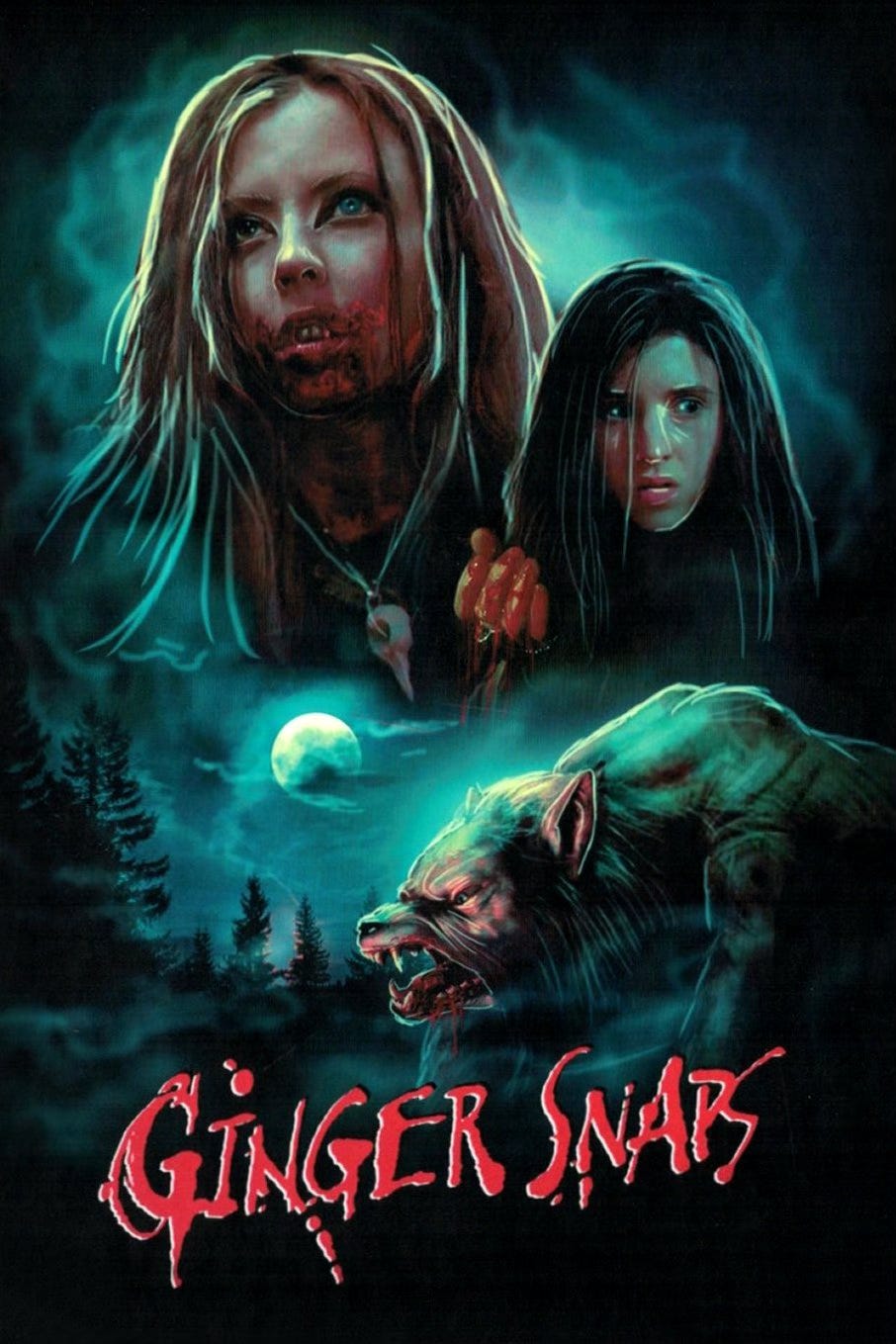
Ginger Snaps
In Ginger Snaps (2001) we have what I believe is one of the best werewolf films. Full stop.
Written by Karen Walton, loosely based on her own gothy teen-age years, we have the story of older sister Ginger (Katharine Isabelle), and younger sister Bridgette (Emily Perkins, the OG Beverly Marsh). The film’s inciting incident occurs when the sisters are cutting across a playground at night on their way home and Ginger happens to get her period, “the curse,” for the first time, then she is attacked by a werewolf. Her subsequent transformation into womanhood over the following month parallels her transformation into a werewolf, both to occur around the next full moon. Ginger experiences cramps, a heavy period, excessive body hair (“I can’t have a hairy chest, B! That’s fucked!”), and the rest of the pubescent glories of transformation from girl into the woman, parallel to her transformation into werewolf.
Director Jon Fawcett said that one of his goals with the film was to emulate David Cronenberg’s filmic “body horror,” but despite the graphic werewolf attacks in the film, much of the so-called body horror stems from Ginger’s perfectly natural transformation. In one of the movie’s most powerful and funny sequences, Bridgette and Ginger are standing in a bathroom stall to wonder at the wolf attack, her freakish healing and sprouting hair, when Ginger’s menstrual blood plops onto the floor between her white shoes. In this moment, the film’s body horror has more in common with Kristeva AND puberty angst than Cronenberg. Menstruation and puberty are displayed as both natural AND the abject. When the school nurse tells the girls that a first heavy period is natural, that they have this to look forward to “every 28 days for the next 30 years,” we see the color drain out of both girls’ cheeks as they slink down further down in their chairs.
Ultimately, Ginger embraces these changes and herself as a “fucking force of nature.” She subverts male expectations for women by becoming the sexual aggressor and ultimately a killer. She tells her sister that they can both use males’ (low) expectations to their advantages: “No one thinks chicks do things like this. Trust me, a girl can only be a slut, a bitch, a tease, or the virgin-next-door. We will coast on how the world works.”
Ginger Snaps stands in a class by itself, featuring a truly well-developed and self-actualized female werewolf who is central to the narrative. She embraces her time of the month and possesses great agency. Ginger, never a victim, challenges stereotypical roles for women in movies, just as Julia Roberts’ hairy armpits challenge what we expect to see when a “pretty woman” waves for the camera.
Two More Fantastic Filmic Female Werewolves:
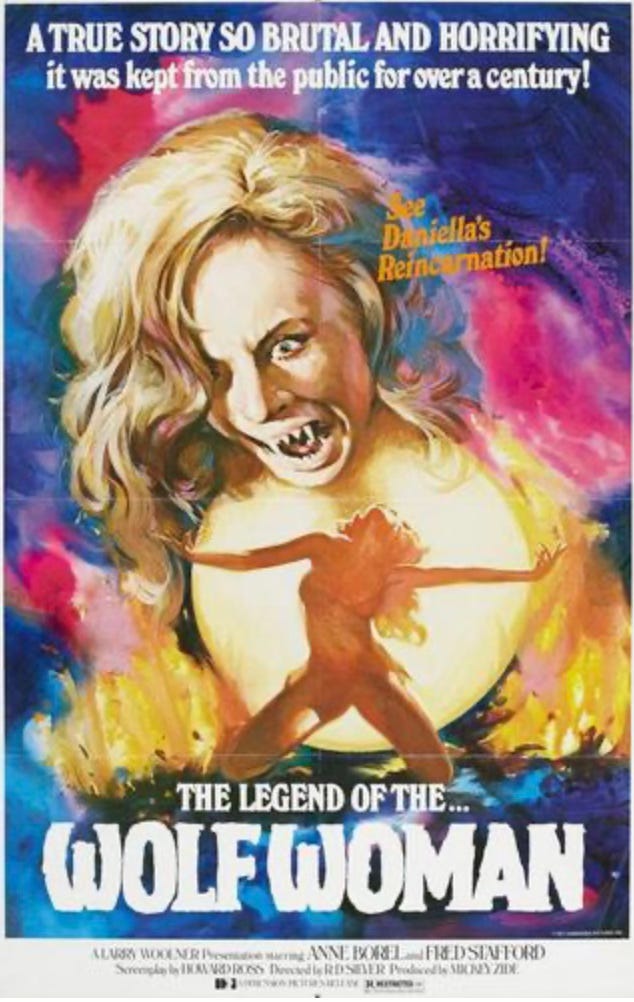
Werewolf Woman, Italian: La lupa mannara, AKA The Legend of the Wolf Woman (1976), dir. Rino Di Silvestro - Daniela dreams of becoming a snarling, hairy beast, and because a male psychologist diagnoses her with the very real psychological condition of lycanthropy, the werewolf is very much a part of this film.
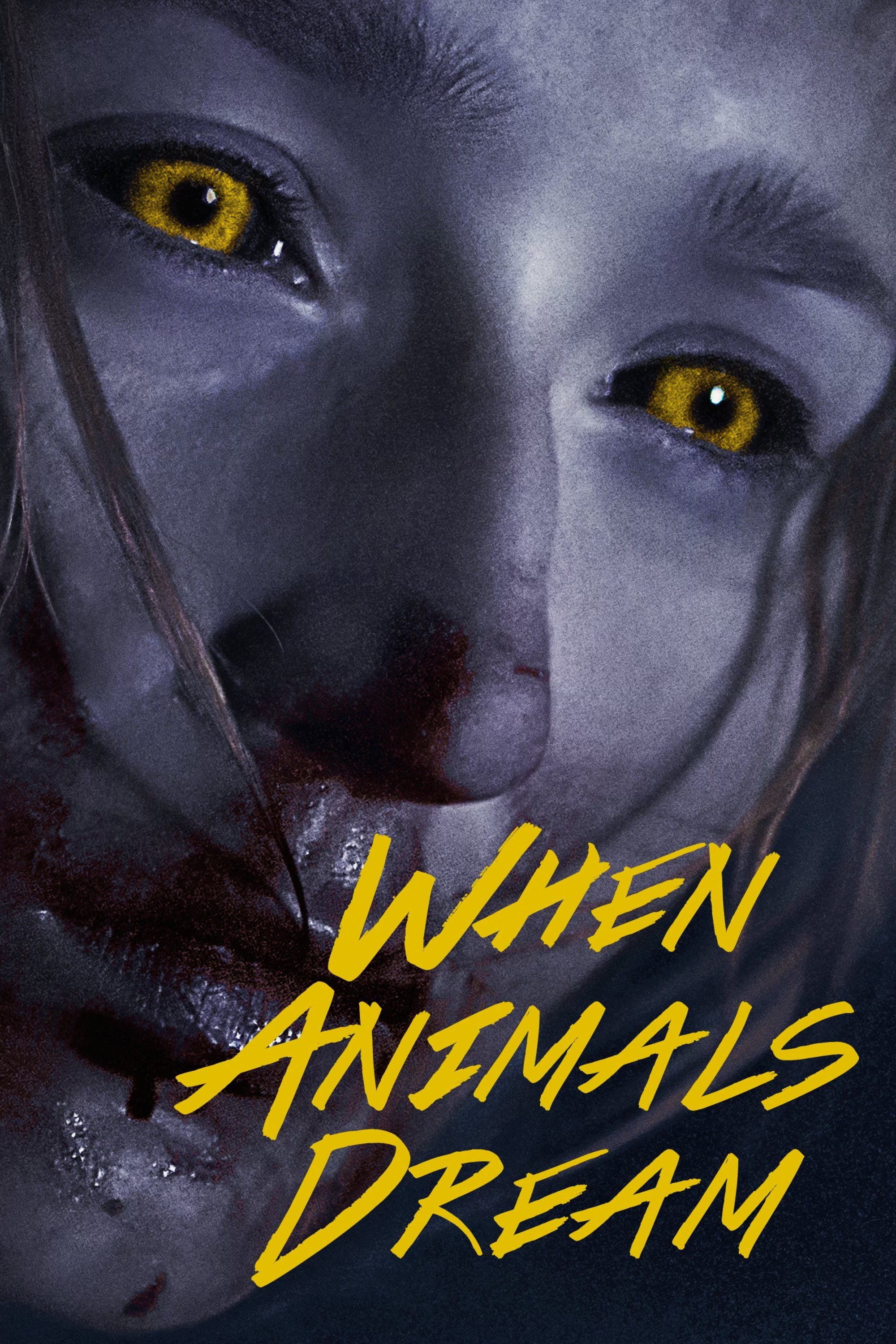
When Animals Dream, Danish: Når dyrene drømmer (2014), dir. Jonas Alexander Arnby - This film continues to explore the female werewolf as an analogy for adolescence and a young woman’s desire for agency. Director Arnby and writers Rasmus Birch and Christoffer Boe examine Marie who, like Ginger, is on the edge of adolescence. Again, her burgeoning womanhood and sexuality parallel her coming werewolf transformation. A gorgeous and moving film.
For Further Reading
The Powers of Horror: An Essay on Abjection (1980), Julia Kristeva
“When Woman Looks” (1984), Linda Williams
And for more about female werewolves and other monsters, see also the collection I helped edit, Monsters of Film, Fiction, and Fable: The Cultural Links between the Human and Inhuman
Edited By: Lisa Wenger Bro, Mary Ann Gareis, Crystal O’Leary-Davidson
Love this. You’re so right about Ginger getting her period being a part of the body horror. And on women’s body hair… oh the typical American reaction to it tickles me greatly. It’s literally what naturally grows there for many women. Yet it’s seen as unsanitary. Go razor, wax, laser yourself. I think body hair on anyone can be very attractive. ((And I think the hairless demands on women stem from pedophilia+capitalism mostly but that’s a different essay lol). Anyway. Appreciated this. Thank you.
This is such a great essay, Crystal. All it takes for a little body horror is to subvert beauty standards. Lol